研究成果
Are Smart Cities Smarter? The Impact of Smart City Policy on Digital Autonomy of Cities in China(智慧城市更智慧吗?——中国智慧城市政策对城市数字自主性的影响)
Mao, F., Wei, Y., &Ren, J. (2023). Are Smart Cities Smarter? The Impact of Smart City Policy on Digital Autonomy of Cities in China. Polish Journal of Environmental Studies, 33.3.
摘要
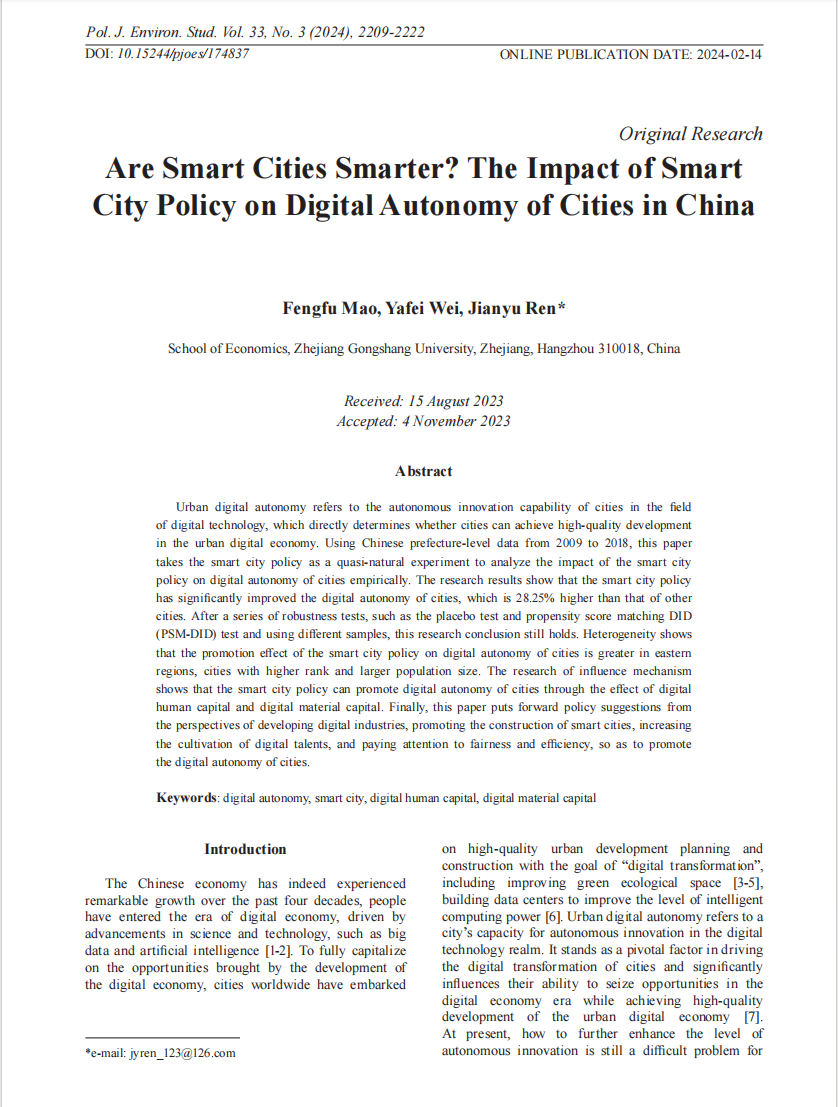
Urban digital autonomy refers to the autonomous innovation capability of cities in the field of digital technology, which directly determines whether cities can achieve high-quality development in the urban digital economy. Using Chinese prefecture-level data from 2009 to 2018, this paper takes the smart city policy as a quasi-natural experiment to analyze the impact of the smart city policy on digital autonomy of cities empirically. The research results show that the smart city policy has significantly improved the digital autonomy of cities, which is 28.25% higher than that of other cities. After a series of robustness tests, such as the placebo test and propensity score matching DID (PSM-DID) test and using different samples, this research conclusion still holds. Heterogeneity shows that the promotion effect of the smart city policy on digital autonomy of cities is greater in eastern regions, cities with higher rank and larger population size. The research of influence mechanism shows that the smart city policy can promote digital autonomy of cities through the effect of digital human capital and digital material capital. Finally, this paper puts forward policy suggestions from the perspectives of developing digital industries, promoting the construction of smart cities, increasing the cultivation of digital talents, and paying attention to fairness and efficiency, so as to promote the digital autonomy of cities.
城市数字自主性是指城市在数字技术领域的自主创新能力,直接决定城市数字经济能否实现高质量发展。本文利用2009—2018年中国地级市数据,将智慧城市政策作为准自然实验,实证分析智慧城市政策对城市数字自主性的影响。研究结果表明,智慧城市政策显著提升了城市数字自主性,提升幅度约为28.25%;经过安慰剂检验、倾向得分匹配双重差分(PSM-DID)检验及更换样本等一系列稳健性检验后,该结论依然成立。异质性分析显示,智慧城市政策对东部地区、行政级别较高和人口规模较大城市数字自主性的提升作用更大。影响机制研究表明,智慧城市政策通过数字人力资本和数字物质资本两个渠道促进城市数字自主性提升。最后,本文从发展数字产业、推进智慧城市建设、加大数字人才培养以及兼顾公平与效率等角度提出政策建议,以促进城市数字自主性提升。